
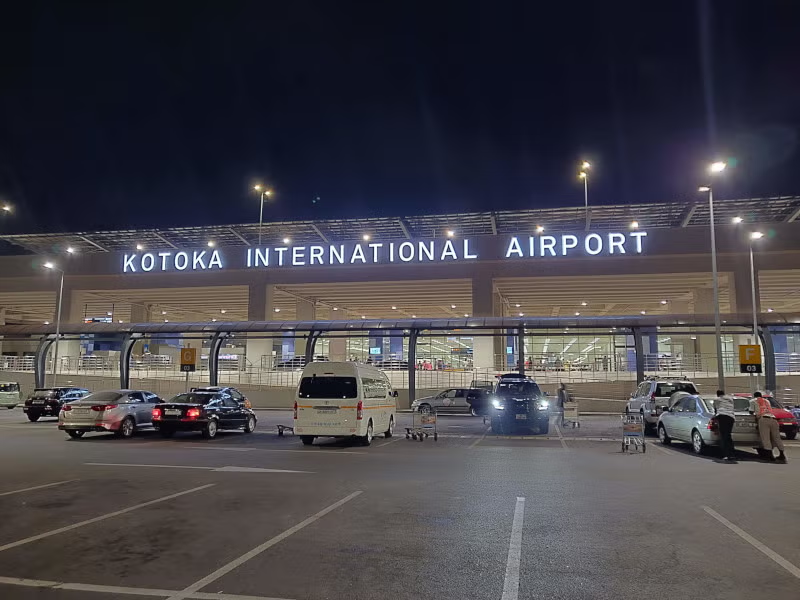
At the heart of the Kotoka International Airport sits the shiny new ‘Terminal 3’ building that facilitates movement of several hundreds of passengers coming into Ghana or going out every day. The terminal project was started in March 2016 at a cost of $30 million at a time when passenger traffic at the nation’s premier international airport had increased due to heightened economy activity in the country. The project was completed in June 2018 and opened to traffic in September 2018. However, between 2017 and 2019, the terminal had generated some $5.5 million as return on investment to the Ghana Infrastructure Investment Fund which mobilised capital towards the construction of terminal 3, but the Public Interest and Accountability Committee notes that GIIF has been severely hampered by the decision of the government to take it off the Annual Budget Funding Amount.
Prior to the amendment of the Petroleum Revenue Management Act in 2025, a portion of the national budget was meant to go to the Ghana Infrastructure Investment Fund for a range of infrastructural projects across the country therefore per the new arrangement all such infrastructure projects will now be financed exclusively by the ABFA.
Hitherto, GIIF which received 25% from the ABFA in each budget cycle was used to fund government projects including the Kotoka terminal 3, free senior high school, and Agenda 111 among others. PIAC, an accountability committee established by Act 815 is mandated to monitor and report on the use of petroleum proceeds in accordance with the PRMA has now been placed under the consolidated fund. According to PIAC, the new arrangement in the 2025 amendment of the Act now provides that its funding for operations and allowances is determined by the Minister of Finance based on a budget submitted to the minister on its annual programme for the financial year. Furthermore, the government’s decision was necessitated by the Mahama administration’s “big push” infrastructure programme to be entirely funded by the ABFA which the committee warned could lead to ‘sporadic’ utilisation of petroleum funds based on electoral promises by whichever political party in government.
“So the amendment has taken away the requirement that the utilisation of the ABFA should align with a long-term national development plan approved by Parliament”, noted PIAC
“I’m sure that you must have heard PIAC repeat this, that the nation should develop a long-term national development plan to guide the utilisation of the ABFA, and that if we do not do that, the utilisation will be sporadic. It will be partisan. This party will come, it will use the revenue for this, and the next party will come and say we will not continue because it is this party that did that. And to have to forestall all that, there should be a long-term national development plan to guide the utilisation. Unfortunately, this has been taken out of the act. So this is it. [Section] 21.3. The annual budget funding amount shall be used for infrastructure development.”

The first half of the year 2025 saw a total of 18,415,410 barrels of crude oil produced, marking a 25.92% decline from 24,857,478 bbls as at same period in 2024, from all 3 oil fields in Ghana’s Cape Three Points region contributing a revenue of $370,343,681.17 out of which $148,277,731.53 (53%) was allocated to ABFA. Cumulatively, Ghana has received a total of $11.4 billion from petroleum revenue since 2011 and distributed amongst ABFA, GNPC, GSF, GHF, and the PHF minimum balance with the ABFA receiving 40% the highest share of the petroleum holding fund. Ghana has been unable to attract new investments in the upstream petroleum industry to the extent that no new petroleum agreement has been signed since 2018 which has contributed in part to the dwindling fortunes of the sector.
PIAC in a recommendation to the government reiterated its call to the Ministry of Energy and its allied agencies to urgently “increase efforts to arrest the decline in crude oil production and secure investments into Ghana’s upstream petroleum industry”. Even though an amount of $146.36 million was allocated to ABFA for the big push programme, no expenditure was incurred for the period under review making calls by PIAC for the need to develop a broad-based long-term national development plan approved by Parliament to ensure continuity in the utilisation of Ghana’s natural resources for development including the ABFA.